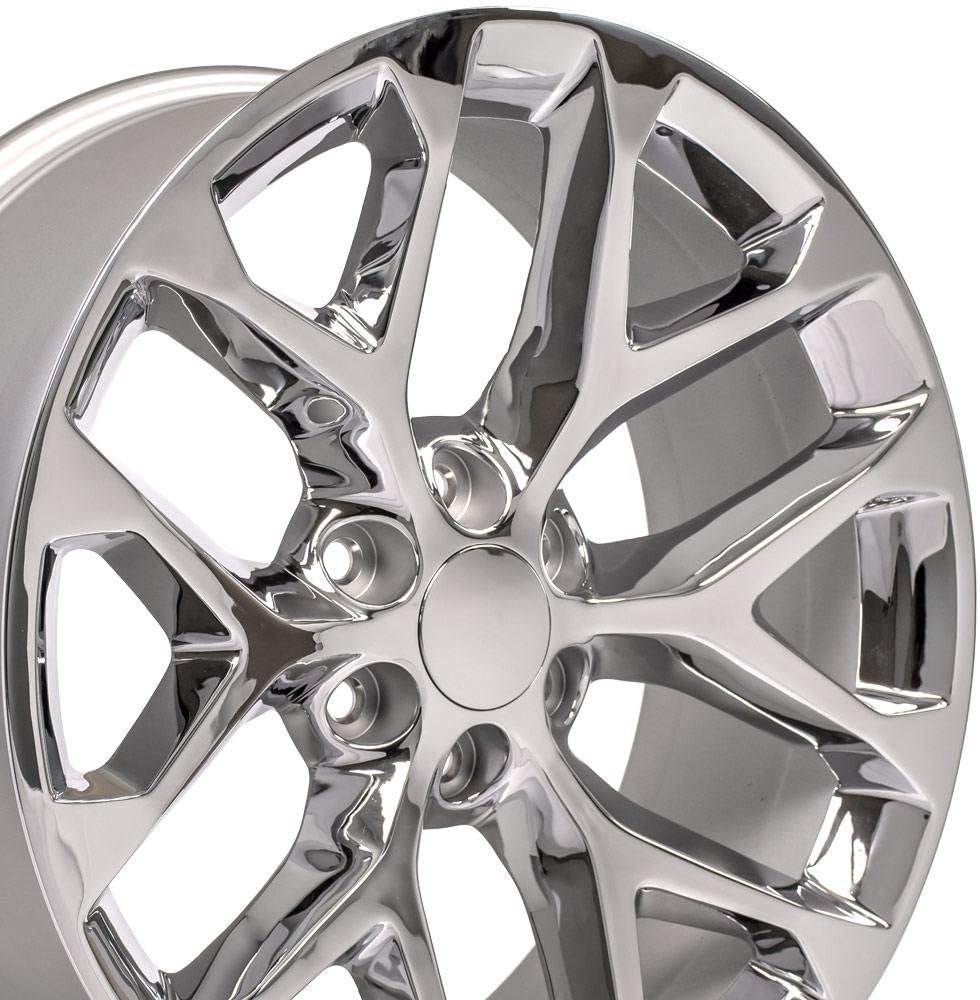
If you’ve ever walked a car show and stopped dead in front of an Escalade rolling on massive, mirror-polished chrome wheels, you already know the appeal. Chrome wheels — real chrome-plated or chrome-finished aluminum alloy wheels — catch light the way painted or brushed finishes simply don’t, and on a full-size GM truck or SUV the effect is dramatic. But “chrome wheels for a Silverado” is not a one-click purchase. Two numbers govern whether an aftermarket wheel fits your truck without shimmy, vibration, or a dangerous failure: the bolt pattern (the arrangement of the lug holes that attach the wheel to the hub) and the hub bore (the center hole that centers the wheel over the axle). Get those right and you’re making a style decision. Get them wrong and you’re making a safety decision — the wrong way. This guide walks through the math on both, explains GM’s OE “snowflake” wheel design so you know exactly what you’re replacing, and gives you a clear decision framework for choosing chrome aftermarket wheels for Escalade, Tahoe, and Silverado platforms.
The Bolt-Pattern Foundation: What 6×139.7 Actually Means
The GM full-size truck and SUV platform — covering the Chevrolet Silverado 1500, GMC Sierra 1500, Chevrolet Tahoe, GMC Yukon, and Cadillac Escalade in their most recent generations — shares a common bolt pattern: 6×139.7 mm, sometimes written as 6×5.5 inches. The first number (6) is the count of lug bolts; the second (139.7 mm) is the diameter of the imaginary circle those bolts sit on, called the bolt circle diameter (BCD). Any aftermarket wheel labeled 6×139.7 will align its six holes to your truck’s six studs.
That sounds simple, and for the most part it is. The complication enters when shoppers confuse the GM 6-lug pattern with Toyota’s 6×139.7 or with other GM applications. Per Tire Rack’s wheel fitment guide for GM full-size trucks and SUVs, the 6×139.7 bolt circle is consistent across 1999–present Silverado 1500, Tahoe, Yukon, Escalade, and Avalanche platforms, meaning an enormous aftermarket wheel catalog is technically bolt-compatible across roughly 25 model years. That’s buyer-friendly. What changes across those years — and what causes fitment problems — is the hub bore.
Hub Bore: The Number Most Buyers Miss
The hub bore is the center hole in the wheel. Your truck’s hub (the rotating axle component) has a corresponding raised collar. When the two match precisely, the wheel is hub-centric — meaning the axle hub carries the centering load, and the lug nuts carry only the clamping load. This is how factory wheels work, and it’s why your factory wheels never vibrate at highway speed. Per Tire Rack’s resource on hub-centric versus lug-centric installation, GM’s full-size 6-lug platform uses a 78.1 mm hub bore on most applications (Escalade, Tahoe, Yukon, Silverado 1500).
When you buy an aftermarket wheel with a larger center bore — common with universal-fit wheels designed to sell across multiple vehicle lines — you can use hub-centric rings (inexpensive plastic or aluminum sleeves that close the gap) to restore proper centering. Skipping hub rings on a wheel with a mismatched bore is the most common cause of high-speed vibration that doesn’t respond to balancing. SEMA’s wheel standards and aftermarket fitment best practices documentation explicitly identifies hub-bore mismatch as a leading root cause of aftermarket wheel vibration complaints. The fix costs under $20. The diagnostic bill for chasing phantom vibration costs considerably more.
Understanding the OE Snowflake: What You’re Replacing and Why It Matters
GM’s factory “snowflake” wheel — formally an OE multi-spoke polished or machined alloy — has been a signature design element on Escalade and Tahoe trims since the early 2000s. The name comes from the intricate symmetrical spoke pattern that radiates from the center cap, which genuinely resembles a snowflake at distance. Depending on trim year and vehicle line, OE snowflake diameters have ranged from 20 inches (early 2000s Escalade ESV) up to 22 inches on higher ESV and Platinum trims by the 2021–2024 generation.
Why does knowing this matter for chrome wheel shopping? Two reasons:
1. Offset. The OE snowflake is engineered to a specific offset — the distance in millimeters between the wheel’s centerline and the face that mounts to the hub. A positive offset means the mounting face is toward the outside of the wheel; a negative offset pushes it inward. GM’s factory 22-inch Escalade wheel typically runs an offset in the +24 mm range, per Motor Trend’s fitment reference data for the full-size GM platform. An aftermarket chrome wheel with dramatically lower offset (more negative, more “poke” outward) will push the tire outward, potentially rubbing the inner fender liner on turns or creating a stance the driver didn’t anticipate. Most reputable chrome aftermarket wheels for this platform — DUB, Lexani, Giovanna, Wheel Pros — are cataloged with OE offset ranges specifically so you’re not guessing.
2. Load rating. The OE snowflake is load-rated for the vehicle’s GVWR (gross vehicle weight rating). A visually identical chrome replica from an unknown source may not be. This is the counterfeit wheel problem in concrete form: beautiful finish, unverified structural integrity.
By the Numbers: GM Full-Size Fitment Quick Reference
| Vehicle | Bolt Pattern | Hub Bore | Common OE Wheel Size | Typical OE Offset |
|---|---|---|---|---|
| Escalade (2021–2024) | 6×139.7 mm | 78.1 mm | 22 in | ~+24 mm |
| Tahoe / Yukon (2021–2024) | 6×139.7 mm | 78.1 mm | 20–22 in | ~+24 mm |
| Silverado 1500 (2019–2024) | 6×139.7 mm | 78.1 mm | 18–20 in | +24 to +44 mm |
Source: Tire Rack wheel fitment guide; Car and Driver 2024 Escalade specs.
Chrome Finish Types: Real Chrome vs. Chrome-Look and Why the Gap Matters
Not every wheel marketed as “chrome” is actually chrome-plated aluminum. Understanding what you’re buying changes both the price expectation and the long-term maintenance plan.
True chrome plating involves electroplating layers of copper, nickel, and finally chromium over a cast aluminum base. The result is a mirror-bright finish with genuine depth. True chrome wheels from brands like DUB, Lexani, and Giovanna at the $800–$2,000+ per-set tier are typically triple-plated and carry a measurable surface hardness advantage. Owners of high-end triple-chrome wheels consistently report that surface durability in road-salt environments is meaningfully better than single-layer budget chrome, though all chrome wheels require more careful washing than painted or powder-coated finishes — road salt and brake dust are the enemy.
Chrome-look (PVD chrome or chrome paint) describes wheels with a reflective appearance achieved through physical vapor deposition or metallic paint. These are less expensive — often the $200–$800 range for a set — and can be very attractive, but the finish is less durable and will show wear differently than true chrome. Budget-tier chrome spinner hubcap sets ($20–$80) almost universally use chrome-look paint over plastic; they’re fine for novelty applications on show cars that never see rain.
The counterfeit problem. RimSpinners.com has covered this extensively because it’s where buyers get burned: replica “chrome Giovanna” or “chrome DUB” wheels sold through unverifiable marketplace sellers often fail to disclose whether the bolt pattern spec is accurate, whether the hub bore is correct, or whether the load rating meets OE minimums. SEMA’s fitment best practices documentation recommends purchasing from authorized dealers or retailers with documented fitment guarantees and VIN-verification tools. Tire Rack’s wheel fitment guide similarly surfaces load rating and TPMS sensor compatibility as the two most frequently overlooked specs in aftermarket chrome wheel purchases.
TPMS Sensors: The Hidden Cost That Surprises First-Time Buyers
If your Escalade, Tahoe, or Silverado was built after 2007, it has a TPMS system — tire pressure monitoring sensors mounted inside the wheel, one per corner, that communicate with the vehicle’s onboard computer. When you swap to aftermarket chrome wheels, you have two choices: transfer your OEM TPMS sensors to the new wheels (requires a tire shop to dismount and remount, typically $15–$30 per corner), or purchase new aftermarket TPMS sensors compatible with GM’s protocol. Per Car and Driver’s Escalade coverage and broader GM fitment reporting, GM full-size trucks use a 433 MHz sensor frequency; universal programmable sensors from brands like Dorman and Schrader are cataloged to this spec and typically run $25–$60 per sensor retail.
Skipping TPMS resets entirely results in a persistent dashboard warning light and, more seriously, the loss of an active safety feature on a 6,000-pound SUV. This cost is almost never included in the sticker price of an aftermarket wheel set and frequently surprises buyers who budgeted only for wheels and tires.
The full cost stack on a chrome wheel swap (mid-range build, Escalade):
- Chrome aftermarket wheels (set of 4, mid-range): $600–$1,200
- Mount and balance (per tire, at a shop): $20–$35 × 4 = $80–$140
- Hub-centric rings (if needed): $10–$25
- TPMS sensor transfer or new sensors: $100–$240
- Lug nuts (many chrome wheels require open-end or ball-seat lugs, not the OE conical): $30–$80
Total realistic installed cost on a mid-range chrome set: $820–$1,685. Budget accordingly before you fall in love with a wheel on a product page.
Decision Framework: If X, Then Y
You’ve absorbed the math. Here’s how to map it to your actual situation:
If you’re building a show Escalade or Tahoe and want maximum visual impact with low maintenance risk: Source triple-chrome plated 22-inch wheels from an authorized DUB, Lexani, or Giovanna dealer, confirm 6×139.7 bolt pattern and 78.1 mm hub bore, and verify offset is within ±5 mm of OE spec unless you’re intentionally modifying stance. Expect to spend $1,200–$2,000 for the wheel set alone, plus the install cost stack above.
If you’re outfitting a working Silverado 1500 that occasionally hits car shows: A quality PVD or chrome-look wheel in the $400–$800 range (set of 4) is a legitimate choice. Confirm the same bolt pattern and hub bore specs; load rating matters more on a truck that carries weight. Don’t scrimp on TPMS sensors.
If you’re buying for a client build at a fabrication shop: Verify the vehicle’s hub bore with a caliper before ordering — late-production run changes occasionally introduce variation from catalog specs. Order hub rings as a matter of standard practice regardless. Your margin disappears fast if you’re remounting wheels a second time.
If the listing doesn’t specify hub bore or load rating: Walk away or demand the spec sheet. Chrome finish is irrelevant if the wheel doesn’t fit safely. Per SEMA’s fitment best practices, a wheel manufacturer that can’t provide a load rating on request is a supplier worth avoiding.
The bolt-pattern math on GM full-size trucks is genuinely buyer-friendly — 6×139.7 opens up a huge catalog across a quarter-century of production. The fitment discipline is in the details: hub bore, offset, TPMS, and lug seat type. Get those four items confirmed before you fall in love with the finish, and the chrome decision becomes a style decision, which is exactly where it should live.