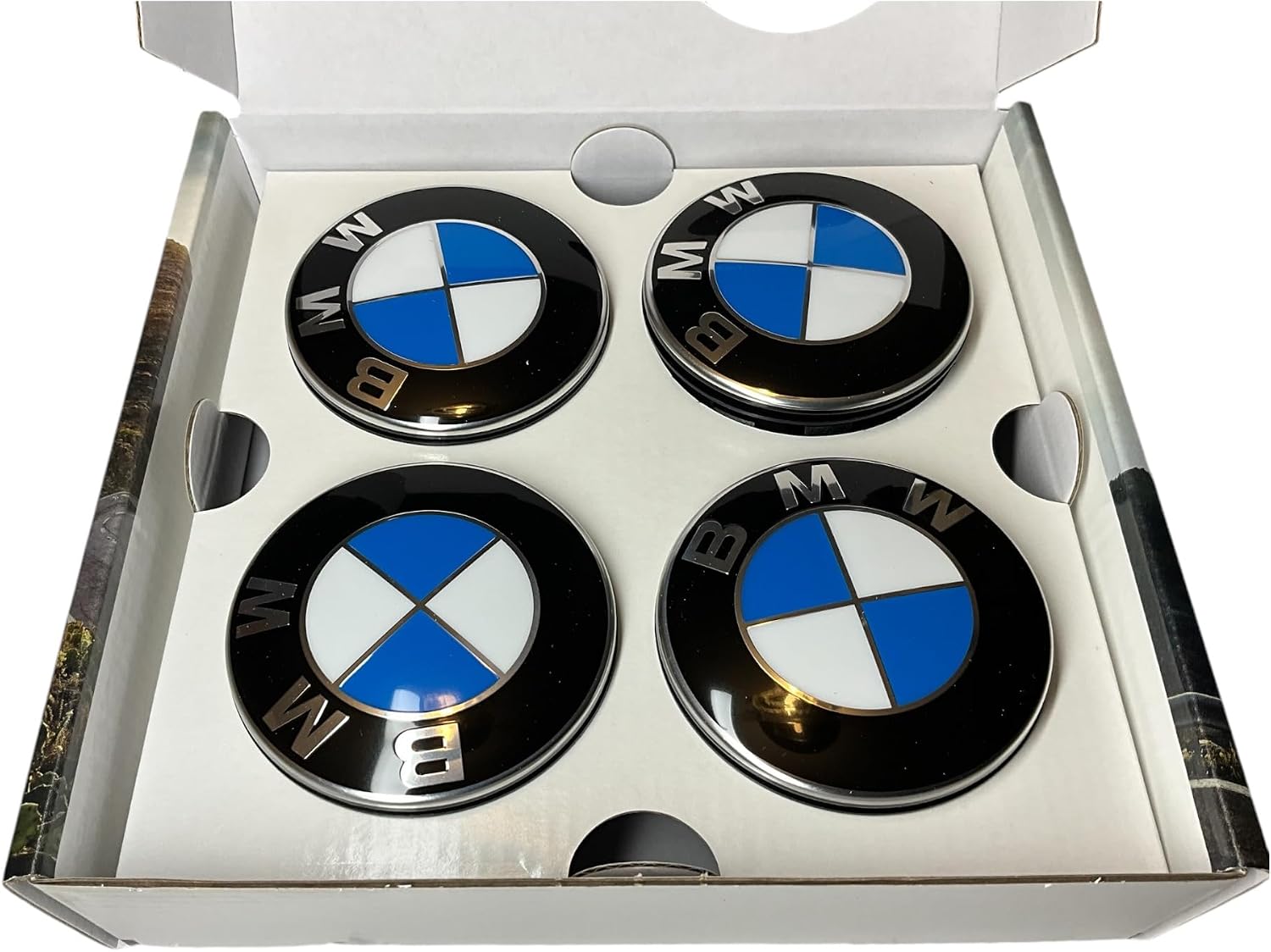
If you’ve ever looked at a finished wheel and noticed that small round piece sitting right in the center — covering the lug nuts and hub — that’s the center cap. It’s the finishing detail that turns a bare wheel into something that looks intentional and complete. On a factory wheel, the center cap usually carries the automaker’s logo. On a custom aftermarket wheel, it might be a polished billet disc, a spinning floater insert, or a branded emblem from the wheel manufacturer. The cap itself sounds simple, but this is where a surprising number of builds go sideways: the wrong diameter, the wrong retention clip style, or a “universal” part that fits nothing quite right. This guide breaks down how OEM replacement caps, floating BMW-style caps, and universal caps differ — and gives you a clear decision rule for choosing the right one before you spend money on something that won’t fit.
| EDITOR'S PICK[BMW 36122455269 Floating Center…](https://www.amazon.com/dp/B07T3GTYF6?tag=greenflower20-20) | Mid-tier[Mercedes Benz Center Hub Caps f…](https://www.amazon.com/dp/B07C2KL395?tag=greenflower20-20) | Budget pickVW 3B7-601-171-XRW Volkwagen Ce… | |
|---|---|---|---|
| Fitment | 5x120 Bolt Pattern | — | — |
| Size | 65mm | — | — |
| Spinner Type | Floating | — | — |
| Quantity | Set of 4 | Set of 4 | — |
| Price | $96.99 | $66.89 | $20.50 |
| See on Amazon → | See on Amazon → | See on Amazon → |
What “Fitment” Actually Means for a Center Cap (and Why It’s Trickier Than It Looks)
Center cap fitment comes down to three measurements that have to align simultaneously:
Outer diameter — the outside measurement of the cap itself, which has to match the center bore opening (the round hole in the middle of your wheel). If the cap is too small, it falls inward. Too large, and it won’t seat at all.
Center bore — the diameter of that center hole in the wheel, measured in millimeters. Every wheel has one. Tire Rack’s wheel fitment documentation notes that OEM wheels are manufactured hub-centric, meaning the center bore is machined to match the vehicle’s hub diameter exactly. Aftermarket wheels vary — some are hub-centric, some are lug-centric (meaning the lug nuts carry all the centering load).
Retention method — how the cap actually stays in place. This is where the “universal fit” promise collapses most often. OEM caps typically use vehicle-specific snap tabs, turn-lock bayonets, or spring clips machined to the wheel’s cap pocket geometry. Aftermarket caps use their own systems — and those systems are proprietary to each wheel brand.
The practical consequence: a cap listed as “fits 74mm bore” might physically drop into the hole but have tabs that don’t engage, leaving you with a cap that vibrates loose at highway speed. Motor Trend’s aftermarket wheel buyer’s guide calls out center cap retention as one of the most overlooked fitment specs among first-time custom wheel buyers.
OEM Replacement Caps: The Right Move When You Just Need What Was There Before
If you’re replacing a lost or cracked factory center cap on an OEM wheel — or a factory-spec wheel on a daily driver — the path is straightforward: match the OEM part number.
Why does this matter? Because automakers tolerance their cap pockets very tightly. A BMW center cap, for example, carries the blue-and-white roundel logo and uses a specific 68mm outer diameter with a turn-and-lock retention collar. A Mercedes-Benz cap at 75mm uses a completely different clip geometry. These are not interchangeable, even though both are German luxury vehicles and both look vaguely similar on a shelf.
By the numbers — common OEM center cap diameters:
| Make | Typical OEM Cap OD | Retention Type |
|---|---|---|
| BMW (F/G series) | 68mm | Turn-lock bayonet |
| Mercedes-Benz (W213/W167) | 75mm | Spring-tab snap |
| Cadillac Escalade (2021+) | 84mm | Multi-tab snap |
| Lincoln Navigator (2022+) | 78mm | Push-fit w/ tab ring |
SEMA’s aftermarket wheel standards documentation confirms that OEM fitment references — including cap bore diameter — are vehicle-specific and should never be assumed to cross over between brands, even within the same parent company (e.g., GM brands don’t share cap geometry with Ford brands despite similar hub diameters on some platforms).
If you’re sourcing OEM replacements, use the factory part number or cross-reference against a confirmed fitment database. Owners across forums consistently report that generic “OEM-style” caps sold through mass-market channels arrive with tabs spaced differently than the factory, leading to vibration and road-noise rattle within a few thousand miles.
Floating BMW Caps: The Premium Option That Requires Premium Attention
“Floating” or “floater” center caps — sometimes marketed as spinning center caps — are a specific type of aftermarket cap designed so the outer shell of the wheel spins with the wheel while the center emblem remains stationary (appearing to float in place). The logo stays upright regardless of vehicle speed, which is the visual effect.
This is achieved through a bearing assembly built into the cap itself. The outer ring mounts to the wheel; an inner disc rides on a sealed bearing and stays weighted at the bottom, keeping it level by gravity. Simple in theory, precision-demanding in practice.
BMW fitment is the most commonly referenced application because BMW’s wheel design — particularly on the M-series and the current 5, 7, and 8-series platforms — has a center bore and cap pocket geometry that has become a de facto standard for premium floater cap manufacturers. Many Giovanna and Lexani floater assemblies are designed to the BMW 68mm specification as a baseline, then offered in variant diameters for other applications.
What to verify before ordering a floater cap:
-
The cap’s outer diameter vs. your wheel’s cap pocket — not just the center bore of the wheel, but the recessed pocket depth. A floater cap is thicker than a standard cap (the bearing adds ~12–18mm of stack height). If your wheel has a shallow cap pocket, the floater will protrude visibly and may catch on brake caliper clearances in extreme cases.
-
Bearing quality and seal rating — floater caps exposed to road grit, water intrusion, and temperature cycling fail at their bearings. Per aggregated owner reviews on floater assemblies from the mid-market tier ($80–$200 per cap), the most consistent failure point is bearing contamination after 18–24 months of daily driving in wet climates. Lowrider Magazine’s fitment coverage notes that competition-quality show builds often source sealed ceramic bearing floater caps rather than standard steel-ball versions specifically to avoid this degradation.
-
Weight balance — the counterweight that keeps the emblem upright adds rotational asymmetry to the cap assembly. At speed, a poorly balanced floater introduces micro-vibration that premium wheel sensors (especially TPMS — Tire Pressure Monitoring Systems, the sensors that alert you when a tire is low) can register as noise. This is a known issue documented in Motor Trend’s wheel build coverage: floater caps on TPMS-equipped vehicles occasionally require rebalancing of the full wheel assembly after installation.
-
Replacement bearing availability — if the bearing fails in year two, can you source a replacement bearing, or do you have to buy an entire new cap? This is a real cost trap. Named-brand floater caps from established wheel companies (Lexani, DUB) have documented replacement bearing programs. Off-brand floaters often do not.
The Universal-Fit Trap: Why “Fits Most Wheels” Is a Red Flag
Here’s the scenario: you’re finishing a build, the wheel brand you used is discontinued or the OEM cap is backordered six weeks, and you find a listing for a chrome center cap claiming it “fits 68–75mm bore sizes” with an adjustable clip ring. It’s $18. It looks right.
This is the universal-fit trap.
The adjustable clip ring concept exists — it’s a real engineering solution. But the execution at the low price point is where it breaks down consistently. The clip material is typically thin stamped steel or injection-molded plastic. The adjustment range means the clips are never fully engaged at any specific diameter — they’re always at a compromise tension. Road vibration, temperature expansion, and even the torque load from a pothole impact can unseat them.
SEMA’s fitment standards guidance is unambiguous on this point: wheel center caps should seat and retain using geometry matched to the specific wheel’s cap pocket, not a generalized compression fit. A cap that relies entirely on friction and approximate clip tension is not a proper fitment solution for any vehicle driven on public roads.
The universal cap is appropriate in exactly one scenario: static show display, where the vehicle is trailered to events and never driven under load. Lowrider Magazine’s competition build coverage consistently shows that show trucks and show cars on the circuit use display-specific hardware — including non-structural center caps — that would never survive a daily commute. If that’s your build context, a universal display cap is fine. If the vehicle moves under its own power on public roads, it is not.
The cost difference is also smaller than it looks. A properly fitted OEM replacement or brand-matched aftermarket cap typically runs $25–$65 per cap for the mid-market. A four-cap set from a named aftermarket source costs $100–$250. The universal cap saves you perhaps $60–$80 on a set — and one lost cap at highway speed (a hazard to following traffic, and a replacement cost that wipes out the savings) erases that math immediately.
Decision Rule: If X, Then Y
If you’re replacing a lost or damaged cap on an OEM or OEM-spec wheel on a vehicle that drives daily — use the factory part number or a confirmed OEM-spec replacement from a brand-matched source. Do not substitute.
If you’re building a show or custom vehicle with aftermarket wheels and want the floating logo effect — source a floater cap from the wheel manufacturer’s own accessory line first. If unavailable, match diameter to spec, confirm pocket depth, and buy sealed-bearing versions only. Budget for TPMS rebalancing.
If you found a “universal” cap that claims to fit your diameter — use it only on a static display build. For any driven vehicle, it is a liability, not a solution.
If you’re building a high-end show truck or competition low-rider and the cap is part of the visual presentation — this is worth commissioning from a specialty fabricator. A billet-machined cap set with custom branding, precision-fit to your wheel’s pocket geometry, runs $300–$800 for a set at boutique shops and eliminates every fitment variable. Per Lowrider Magazine’s coverage of competition-level builds, custom billet caps are increasingly standard on the show circuit because judges and photographers notice the difference between a properly seated cap and one with a visible gap or tilt.
The center cap is the last thing someone sees when they look at your wheel. It should be the last decision you treat casually.