If you’ve ever looked at a golf cart sitting in a driveway or at the edge of a fairway and thought “those plain black plastic wheel centers look terrible” — you’re already thinking about hubcaps. A hubcap is the decorative cover that snaps, clips, or bolts over the center of a wheel, hiding the lug nuts and giving the wheel a finished, polished look. On a golf cart, where the wheels are typically 8 inches in diameter measured across the rim opening, hubcaps do the same job they do on a full-size car: they turn a utilitarian-looking wheel into something that actually looks intentional. This guide is for the buyer who already knows they want an upgrade and is now weighing the real decisions — chrome versus stainless steel, snap-on versus bolt-on, and whether the 8-inch fitment universe is as limiting as it sounds. Spoiler: it’s not, but the details matter a lot.
Chrome vs. Stainless: The Material Decision Has Real Consequences
This is the first fork in the road, and most buyers underestimate how much it matters. Chrome-plated hubcaps and stainless steel hubcaps can look nearly identical out of the box. Over time, in real-world conditions, they behave very differently.
Chrome-Plated: Maximum Visual Impact, Finite Lifespan
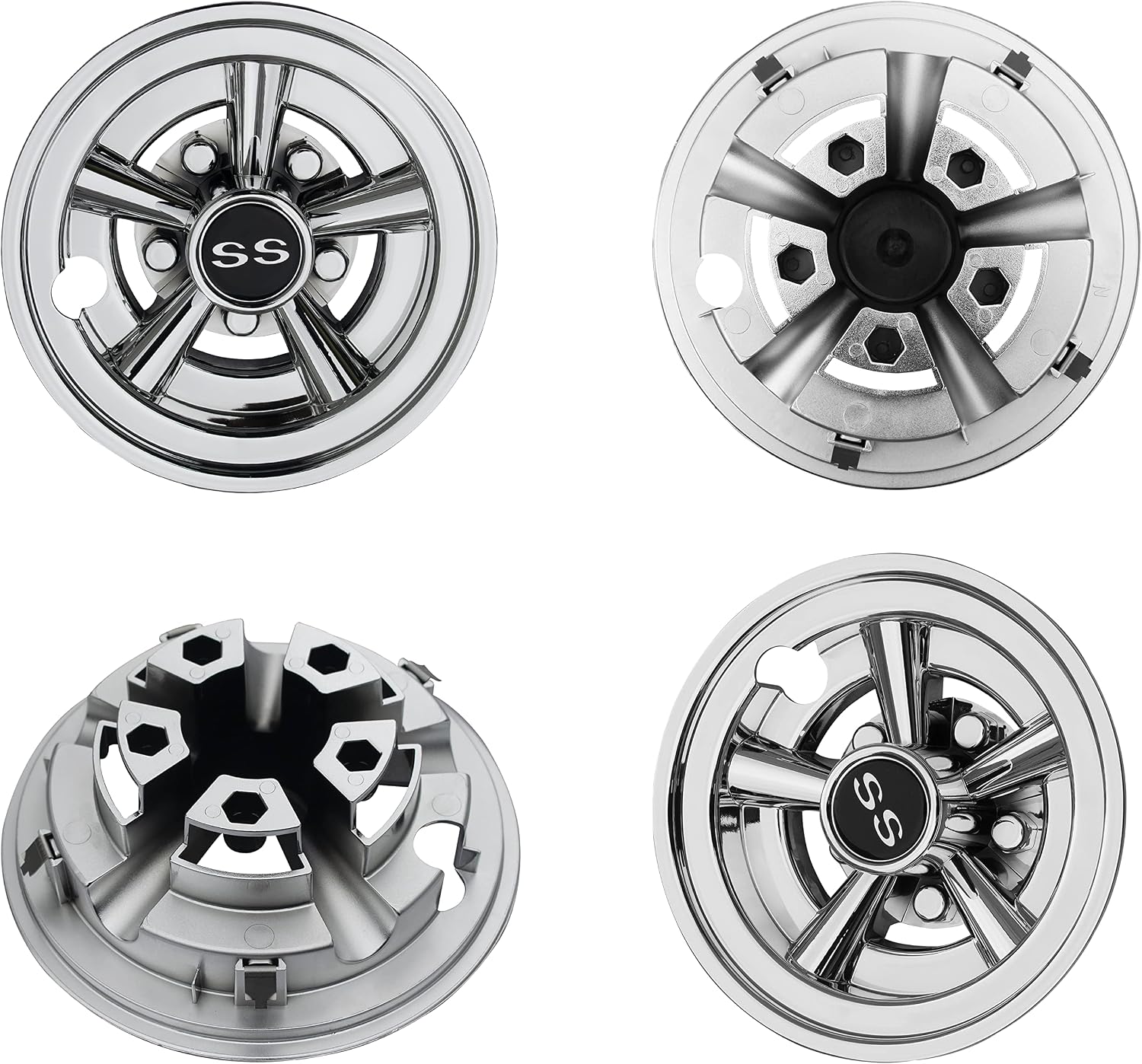
Chrome-plated hubcaps are typically made from an ABS plastic or zinc alloy base that gets electroplated with a thin layer of chromium. The result is a mirror-bright finish that photographs beautifully and catches light aggressively — exactly what show builds and club-level cart customizers are after. The tradeoff is durability. As documented in Hemmings’ editorial guide to custom wheel covers and hubcaps, that plating layer is vulnerable to chipping, peeling, and pitting when exposed to moisture, road salt, or the chemical wash cycles used at cart-rental facilities. Once the plating starts to fail, it fails fast and it fails ugly. Chrome-plated sets in the 8-inch golf cart size typically run $20–$80 for a set of four at retail.
 product image](/images/external/5b7088ee302c.jpg)
[NOKINS](https://www.amazon.com/dp/B085Y3J53T?tag=greenflower20-20)
$29.80
In stock on Amazon
Check price on AmazonStainless Steel: The Maintenance-Free Case
Stainless steel hubcaps use a solid or pressed stainless shell — no plating involved. The finish lands closer to a brushed or satin mirror depending on grade and polish, and it is slightly less reflective than chrome. The functional advantage is that stainless doesn’t peel or pit. Owners across aggregated reviews consistently describe stainless hubcaps as effectively maintenance-free on carts that see real outdoor use: rain, dew, fertilizer runoff on golf courses, and the occasional pressure wash. Stainless sets in the 8-inch size typically run $60–$200 for a set of four — roughly 20–40% more than comparable chrome-plated units.
NOKINS
$30.28
In stock on Amazon
Check price on AmazonPolished Aluminum and Billet: The Premium Tier
At the top of the market, polished aluminum and billet machined caps offer the deepest visual depth of any finish and are a staple of the custom LSV and show-cart world. SEMA’s LSV and golf cart accessory segment market data from 2025 notes a continued trend toward polished aluminum and stainless in this category, driven by buyers learning from early chrome failures and upgrading a second time — a buyer-regret pattern worth avoiding on the first purchase. Polished aluminum caps require periodic re-polishing to maintain their look but resist the catastrophic plating failure that ends chrome’s useful life. Premium sets run $150–$300 or more for a set of four in confirmed manufacturer-specific fitments.
 product image](/images/external/5826e240a74f.jpg)
Set
$102.95
In stock on Amazon
Check price on AmazonThe tradeoff stated plainly:
- Show-only or seasonal-use cart → chrome-plated wins on visual impact per dollar
- Year-round outdoor use, course duty, or rental fleet → stainless wins on total cost of ownership
- High-humidity, coastal, or salt-adjacent climates → stainless is not optional, it’s the correct call
8-Inch Fitment: Understanding the Universe Before You Order
Golf cart wheels are almost universally 8 inches in diameter at the factory, referring to the rim diameter — the metal circle the tire seats against. Most standard golf carts from Club Car, EZGO, and Yamaha ship on 8-inch wheels, though 10-inch and 12-inch aftermarket upgrades exist. If your cart is still on factory wheels, you’re almost certainly in the 8-inch world.
Here’s where buyers get tripped up: 8-inch wheel diameter does not fully define fitment. You also need to confirm three additional specifications:
- Hub bore diameter — the hole in the center of the wheel that the hubcap’s center post or clip must fit through or seat against. This varies between manufacturers and even between model years of the same brand.
- Lug pattern — golf carts typically use a 4-lug configuration, but the bolt circle diameter (the circle the lug holes form) varies. Club Car and EZGO do not share the same bolt pattern.
- Cap depth and offset — a hubcap that’s too deep will contact brake components or hub hardware; too shallow and the retaining clips won’t engage correctly.
Tire Rack’s wheel and hubcap fitment guide states explicitly that hubcap fitment requires matching hub bore and lug pattern independently — diameter alone is not sufficient for a secure fit. This is the most common source of returns in the golf cart hubcap category across major auto accessories retailers.
Typical 8-Inch Golf Cart Fitment Reference:
| Manufacturer | Stock Rim Diameter | Common Lug Pattern | Approx. Center Bore |
|---|---|---|---|
| Club Car DS / Precedent | 8 in. | 4×4.0 in. | ~2.0 in. |
| EZGO TXT / RXV | 8 in. | 4×4.0 in. | ~2.15 in. |
| Yamaha G-Series / Drive | 8 in. | 4×4.0 in. | ~2.0–2.1 in. |
Note: center bore measurements vary by model year; confirm with a caliper before ordering, or use a cap listed as manufacturer-specific fit rather than universal.
The practical advice: buy manufacturer-specific when it exists, and treat “universal 8-inch” listings as a fitment approximation, not a guarantee. Universal caps rely entirely on clip tension, which means on a slightly off-spec hub bore, you’re trusting friction alone — a problem that tends to surface at the worst possible moment.
Snap-On vs. Bolt-On: This Is a Security Decision, Not Just a Style Decision
The attachment method sounds like a minor detail. It isn’t.
Snap-On: Fast Install, Real Ejection Risk
Snap-on hubcaps use spring-steel retention clips, a center push-pin, or a multi-pronged plastic or metal ring that grips the inside of the wheel opening when the cap is pressed in. Installation takes about ten seconds per wheel. Removal is equally fast — sometimes frustratingly so. On smooth pavement at low golf cart speeds (typically 15–25 mph), snap-on caps are generally stable. On rougher terrain — gravel cart paths, maintenance roads, speed bumps taken aggressively — owners consistently report ejection events. Consumer Reports’ auto accessories overview identifies snap-fit wheel covers as the single most common category of accessory complaint related to loss during use. On a cart, “loss” usually means a scratched-up cap at the edge of the fairway rather than a highway hazard, but it’s still a nuisance and a replacement cost.
NOKINS
$29.80
In stock on Amazon
Check price on AmazonBolt-On: Mechanically Positive, Slightly More Work
Bolt-on hubcaps (also called bolt-through or lug-mounted caps) use the existing lug nuts as anchors — either the cap has matching holes that seat over the lugs before the nuts are tightened, or it uses its own fasteners that thread into the hub. This is mechanically positive attachment: the cap cannot depart the wheel unless the lugs themselves loosen. The tradeoff is installation time — 10–15 minutes per wheel, proper torque required — and the fact that every tire rotation or inspection requires cap removal first. For a private cart that never sees a tire shop, that’s a non-issue. For a fleet cart with seasonal inspections, it adds a small but real service step.
NOKINS
$30.28
In stock on Amazon
Check price on AmazonLug-Mounted Billet Caps: Show-Quality Retention
At the top of the attachment hierarchy sit machined billet caps that thread directly onto extended lug bolts or use custom fasteners with decorative caps over each lug point. Hemmings’ guide to custom wheel covers and hubcaps describes lug-point-mounted accessories as the standard approach in show and custom builds precisely because positive mechanical attachment is non-negotiable when a build is meant to last and be transported. These require the most installation effort and the most attention to lug nut seat angle compatibility, but they deliver a finished look that no clip-on cap can replicate from five feet away.
Set
$102.95
In stock on Amazon
Check price on AmazonThe decision rule:
- Paved-only, private property, show or display use → snap-on is fine; prioritize looks and easy seasonal swaps
- Mixed terrain, any course duty, or active daily use → bolt-on is the correct answer; the fifteen-minute install pays for itself the first time you don’t lose a cap on the back nine
- Fleet or rental context → bolt-on only; snap-on caps on high-cycle carts are a recurring consumable cost, not a one-time purchase
What Else Adds to the Real Cost
The sticker price on a set of four golf cart hubcaps doesn’t tell the whole cost story. A few items that commonly get missed:
Hub rings. If your wheel’s center bore is slightly larger than the hubcap’s center post diameter, you’ll get vibration and wobble at speed. Hub-centric rings — small plastic or aluminum spacers that fill that gap — cost $5–$15 for a set and make the difference between a cap that feels solid and one that rattles. Tire Rack’s fitment documentation notes that hub rings are “often necessary and almost never included” with aftermarket hubcap sets. Budget for them.
Valve stem extenders. Some bolt-on hubcap designs cover the valve stem access point. If you inflate tires through the standard Schrader valve, a cap that blocks access requires either a short extender ($3–$8) or a different cap design. Check the product specs before ordering.
Lug nut seat angle compatibility. Some bolt-through caps require a specific lug nut seat geometry — conical versus ball-seat versus flat washer. Hemmings’ wheel cover guide identifies mismatched seat angles as a common fitment problem on lug-mounted accessories across all vehicle categories, including carts and LSVs. A cap that seats crooked is a cap that looks worse than no cap at all.
Wheel surface condition. Snap-on clips can chip painted or powder-coated wheel surfaces over repeated removal cycles. If your wheels are freshly refinished, factor this into the attachment method decision.
The Decision Framework, Stated Plainly
Here’s where to land based on your actual situation:
-
Prepping a show cart or seasonal display vehicle, want maximum visual pop at minimum cost: chrome-plated snap-on caps in a brand-specific 8-inch fitment. Budget $30–$80 for a set of four. Accept that they may need replacement every season or two with heavy handling.
-
Upgrading a daily-use or course-duty cart that sees real weather and real terrain: stainless steel bolt-on caps, manufacturer-specific fitment confirmed for your brand. Budget $100–$200 for the set plus $10–$20 for hub rings and valve stem extenders as needed. This is the set that’s still on the cart three years from now.
-
Building or detailing a cart for a client and want zero callbacks: bolt-on stainless or polished aluminum, fitment confirmed against actual hub bore measurement with calipers, hub rings included in the install. The extra twenty minutes of installation time and $15 in hardware is the cheapest insurance in the job.
SEMA’s 2025 LSV and golf cart accessory market data confirms that supply has matured at the $60–$150 price point in this category — buyers are no longer forced to choose between budget chrome and expensive custom fabrication. The mistake most buyers make isn’t budget, it’s skipping the hub bore measurement and assuming “8-inch universal” covers the gap. It usually doesn’t. Measure once, order right, and the upgrade takes twenty minutes and lasts for years.