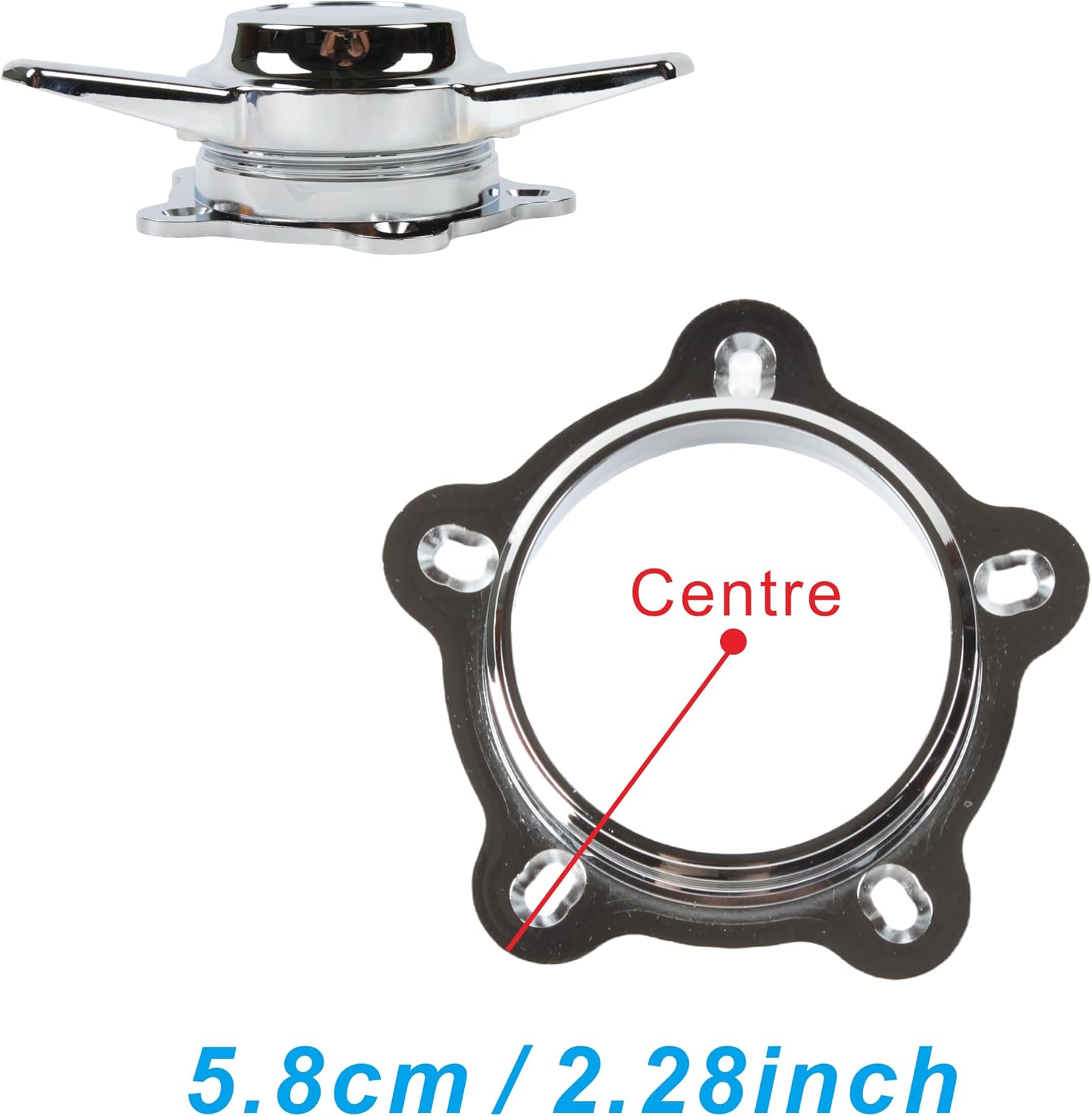
If you’ve ever seen a classic lowrider roll by and noticed the decorative winged center caps spinning freely at the hub while the wheel itself turns — those are knock-off spinner caps, and they’re one of the most recognizable details in custom car culture. “Wire wheels” are spoked metal wheels with a vintage look that’s been central to lowrider builds since the 1960s; the “knock-off cap” (sometimes called a knock-off hub or spinner nut) is the large decorative center piece that originally served a functional role in racing — you’d literally knock it loose with a mallet to remove the wheel fast. On a show car today it’s mostly aesthetic, but the fitment still has to be exactly right. Get the thread pitch wrong, the cap depth wrong, or the spinner clearance wrong, and you’re either dealing with a cap that won’t seat or one that wobbles at low speed and chews up your hub. This guide walks through every measurement that matters, the real cost math behind a correct build, and the if/then decision rules that separate a clean show-car outcome from an expensive redo.
| EDITOR'S PICK14x7 Reverse 100 Spoke Straight… | Mid-tier[2 Ear Swept Knock Off Spinner C…](https://www.amazon.com/dp/B0D9WRDPSG?tag=greenflower20-20) | Budget pickZinc Alloy Chrome 1 Set of 4 fo… | |
|---|---|---|---|
| Include adapters | ✓ | — | — |
| Material | — | Chrome & White Metal | Zinc Alloy Chrome |
| Spinner type | Zenith Knock Off | 2 Ear Swept | Tribar |
| Hole size | — | — | 2.5" |
| Spoke count | 100 | — | — |
| Bolt patterns | 4x100, 4x4.25, 4x4.5 | — | — |
| Price | $1,250.00 | $220.00 | $79.00 |
| See on Amazon → | See on Amazon → | See on Amazon → |
Why Knock-Off Fitment Is More Technical Than It Looks
The cap looks simple. It isn’t.
A wire wheel knock-off cap threads onto a threaded hub extension — called the knock-off hub adaptor or spline drive — that bolts to your wheel hub. That adaptor has to match three things simultaneously: your vehicle’s bolt pattern (the number of studs and the circle diameter they sit on), the thread specification of the cap itself (right-hand or left-hand thread, pitch, and diameter), and the physical depth of the cap so the spinner fins clear the wheel spokes without rubbing.
Lowrider Magazine’s wire wheel buyer’s guide is direct on this point: the most common installation error isn’t buying a bad cap — it’s buying a cap designed for a different hub adaptor standard. The two dominant thread standards you’ll encounter in the U.S. market are the 2-inch 12-TPI right-hand thread common on many Dayton-style and Truespoke assemblies, and the 40mm fine-thread metric standard used on some import-origin wire wheel kits. These are not interchangeable. Cross-threading a metric cap onto an imperial adaptor with hand force is possible, and it destroys both parts.
Left-hand vs. right-hand thread is the other silent killer. On the driver’s side of many wire wheel setups, the knock-off uses a left-hand (reverse) thread so that forward wheel rotation tightens the cap rather than loosening it. If you buy a matched pair assuming both caps are the same thread direction, you’ll have one side that gradually walks off under driving load. Published fitment documentation from Truespoke and Zenith (the two most-cited heritage wire wheel brands in Hemmings Motor News coverage of lowrider restorations) clearly marks left/right thread direction on the cap body — look for an “L” or “R” stamp near the base of the spinner stem.
Spacing and Clearance: The Numbers That Determine Show or No-Show
Once thread match is confirmed, the physical geometry of the spinner cap relative to the wheel face determines whether your build looks like a magazine cover or a near-miss.
Cap depth (the distance the cap protrudes outward from the hub face when seated) has to be less than the clearance between the hub center and the innermost spoke of the wheel. On a 13-inch wire wheel — still the most common size in traditional lowrider builds, per Lowrider Magazine — that clearance is typically 1.75 to 2.1 inches depending on spoke count and wire gauge. On a 14-inch or 15-inch wire wheel built for a heavier platform, clearance opens up slightly but spoke geometry changes too, so you can’t just scale linearly.
Spinner fin diameter matters independently of cap depth. The fins (the wings that make the cap appear to spin) need radial clearance from the spoke heads. A fin that clips a spoke at idle speed produces an audible tick; at 15 mph it can bend a fin or crack a spoke weld. The rule of thumb cited across Lowrider Magazine build features: the spinner fin’s swept diameter should be no more than 70% of the wheel’s hub bore opening diameter — giving you roughly 15% clearance on each side.
By the Numbers: Wire Wheel Knock-Off Cap Sizing at a Glance
| Wheel Diameter | Typical Hub Clearance | Max Cap Depth (Rule of Thumb) | Common Thread Standard |
|---|---|---|---|
| 13-inch wire | 1.75 – 2.1 in | 1.6 in | 2-inch 12-TPI |
| 14-inch wire | 1.9 – 2.3 in | 1.8 in | 2-inch 12-TPI or 40mm metric |
| 15-inch wire | 2.0 – 2.5 in | 1.9 in | Varies by brand |
These are working approximations based on published fitment documentation — always measure your specific assembly with calipers before ordering.
The Lowrider Build Cost Math: Where Knock-Off Caps Sit in the Budget
If you’re pricing a full traditional wire wheel package, it helps to map out where knock-off caps fall relative to the total outlay. The SEMA Specialty Equipment Market Report for 2025 puts the average full wire wheel conversion for a traditional lowrider (four corners, tires, knock-off hardware, hub adaptors, and installation) at $1,400 to $3,200 depending on wheel brand, spoke count, and finish level.
Breaking that down:
- Wire wheels themselves (set of 4): $600 – $1,800 depending on brand (Dayton, Truespoke, or Zenith) and spoke count (72-spoke vs. 100-spoke). Chrome 100-spoke Daytons at the high end of this range carry a premium because the spoke count is a show-circuit signal — Lowrider Magazine consistently identifies spoke count as one of the top three visual differentiators judges evaluate at lowrider shows.
- Hub adaptors (knock-off drive assemblies, set of 4): $80 – $240. This is the piece that bolts to your factory hub and provides the threaded post the cap screws onto. Cheap adaptors are where structural problems originate; Hot Rod Magazine’s coverage of wheel backspacing and offset notes that under-spec hub hardware is the single most common failure point in budget wire wheel installations.
- Knock-off spinner caps themselves (set of 4): $40 – $180 for standard triple-chrome production caps; $200 – $600+ for engraved, custom-colored, or billet-machined examples from specialty fabricators.
- Installation labor: $150 – $400 at a shop experienced with wire wheels. Tire Rack’s fitment documentation notes that wire wheel mounting requires a spoke-pattern-aware lug torque sequence that differs from standard alloy wheel installs — this is not a standard tire shop job.
- TPMS (Tire Pressure Monitoring System) compliance: If your vehicle is 2008 or newer, federal TPMS requirements apply. Wire wheel kits do not inherently accommodate standard TPMS sensors; band-style or flow-through valve sensors are the typical solution at $30 – $80 per corner. Budget this in — it’s a hidden cost that surfaces at the alignment shop and surprises first-time wire wheel buyers.
The knock-off cap is rarely the expensive line item. But it’s the one most likely to require a re-order if you get the thread or clearance spec wrong, which is why getting the measurement discipline right upfront is worth the time.
Counterfeit and Low-Quality Cap Risk: What to Watch For
The knock-off cap market has a counterfeit problem that mirrors the broader replica wheel issue Lowrider Magazine and the lowrider show circuit have documented over the past decade. Import-origin caps sold without brand markings are common at $10 – $25 per cap. Some of these are acceptable for novelty display builds that never turn a wheel at speed. Many are not acceptable for a vehicle that drives to shows.
The failure modes documented in aggregated builder community coverage and Hemmings Motor News restoration features include:
- Chrome delamination within 12 months. Budget caps frequently use a copper strike over zinc die-cast with a thin chrome layer. Owners consistently report peeling at the spinner stem base, which is the highest-stress point.
- Thread slippage under vibration. The spinner stem is threaded into the cap body on quality pieces; on counterfeit versions it’s often press-fit. Vibration from road surfaces works the stem loose, and the spinning element becomes a projectile risk.
- Wrong handed-thread mislabeling. Several import lots have been documented (in Lowrider Magazine tech Q&A columns) as labeled “L” when machined “R.” You won’t catch this until installation.
The protective buy: purchase knock-off caps from a supplier who can confirm the thread direction, cite the adaptor compatibility, and provide a torque specification for the cap stem. If none of those three things appear in the product documentation, treat it as a red flag regardless of price.
Decision Rules: If X, Then Y
You’ve absorbed the geometry and the cost structure. Here’s the clean decision frame for where you likely are right now:
If your build uses 13-inch Dayton or Truespoke wire wheels and original hub adaptors: Source caps with the 2-inch 12-TPI thread spec and a cap depth under 1.6 inches. Confirm thread hand (left driver’s side, right passenger’s side) in writing with the supplier before ordering. Budget $80 – $160 for a quality set of four production chrome caps.
If your build uses 14-inch or 15-inch wheels with newer hub adaptors you didn’t spec yourself: Pull the adaptor documentation or measure the thread OD and pitch with a thread gauge before ordering any cap. Don’t assume the adaptor came with the wheels is 2-inch 12-TPI — metric adaptors are increasingly common in newer wire wheel kits targeting the SUV lowrider segment (Escalade, Suburban, Navigator builds).
If you’re building for competition show judging: Spoke count and cap finish will be evaluated together. A 100-spoke wheel with a dull or pitting cap scores below a 72-spoke wheel with flawless triple-chrome. Allocate cap budget proportionally to wheel budget — if you’re in $1,200+ Daytons, a $30 import cap is the wrong finishing choice.
If you’re on a tight budget and sourcing caps separately from the wheels: Buy one cap first, verify fit on the actual hub adaptor in your hand before ordering the remaining three. The 20-minute test eliminates the most common re-order scenario in this category.
If your vehicle requires TPMS compliance: Confirm with your installer before the wire wheels are mounted, not after. Band-type TPMS sensors are the path of least resistance and can be sourced through Tire Rack’s fitment tool for most late-model platforms.
The wire wheel and knock-off cap combination is one of the most visually iconic elements in lowrider culture — and when the fitment is exact, it reads immediately as the work of someone who knew what they were doing. The math isn’t complicated once you’ve measured twice. The mistake is always in skipping the measurement step.