If you’ve ever been parked next to a gleaming 18-wheeler at a truck stop and noticed those shiny caps covering the center of each wheel — those are chrome hub covers, sometimes called hub caps or hub cover kits. They serve two jobs at once: they protect the lug nuts and hub hardware from road grime, salt, and moisture, and they dress the wheel up so the whole rig looks sharp and intentional rather than industrial and bare. For owner-operators running show-quality trucks, fleet managers trying to project a polished brand image, or custom build shops outfitting a client’s pride-and-joy semi, choosing the right hub cover matters more than it sounds. Get the fit wrong and the cover spins loose at highway speed. Get the style wrong and a $2,000 wheel package looks unfinished. This guide walks you through the two main profile choices — dome and flat top — explains how 33mm thread-on attachment actually works, and lays out the honest total cost of kitting a full truck, so you can make a clean decision and avoid the surprises that catch first-timers off guard.
| EDITOR'S PICK[TORQUE Chrome Front and Rear Ax…](https://www.amazon.com/dp/B07PFL4QH1?tag=greenflower20-20) | Mid-tier[GXYWADY](https://www.amazon.com/dp/B09ZKPXM5G?tag=greenflower20-20) Set of 6 Chrome Semi Tr… | Budget pick[Torque Hubcap Wheel Cover Kit 2…](https://www.amazon.com/dp/B08HVXT6BN?tag=greenflower20-20) | |
|---|---|---|---|
| Includes Rear | ✓ | ✓ | ✗ |
| Includes Tool | ✓ | — | ✓ |
| Pieces | 6 | 6 | 2 |
| Price | $134.99 | $127.59 | $43.79 |
| See on Amazon → | See on Amazon → | See on Amazon → |
Dome vs. Flat Top: The Tradeoff Is Visibility vs. Clearance
The profile of your hub cover isn’t purely aesthetic — it’s a functional decision with real clearance and visibility consequences, and the choice has downstream effects on your whole build. The three tiers below cover every realistic buyer scenario, from show-truck billet work to fleet protection on a tight budget.
Premium Tier: Dome-Style Covers in Billet Chrome
Dome-style covers protrude outward from the wheel face in a rounded, bullet-like profile. That convex shape catches and redirects light beautifully, which is why dome covers dominate the show-truck circuit. The curvature multiplies reflections, making chrome pop even in flat warehouse lighting. Operators on the truck show circuit consistently note that a dome cover reads as premium from thirty feet away in a way that a flat cover simply doesn’t. But the dome adds real dimension — typically 1.5 to 2.5 inches of outward projection depending on manufacturer spec — and on certain specialty or wide-base tire configurations, that projection can encroach on tire sidewall clearance. Before ordering dome covers, measure the gap between your wheel face and the tire sidewall at full steering lock. Fitment documentation from wheel manufacturers and specialty chrome trim suppliers consistently notes that clearance should be confirmed, not assumed, especially on steerable front axles. Motor Trend’s work-truck and show-truck build coverage — published at motortrend.com — has specifically called out steer-axle clearance as the most commonly skipped check in first-time hub cover installations on working semis.
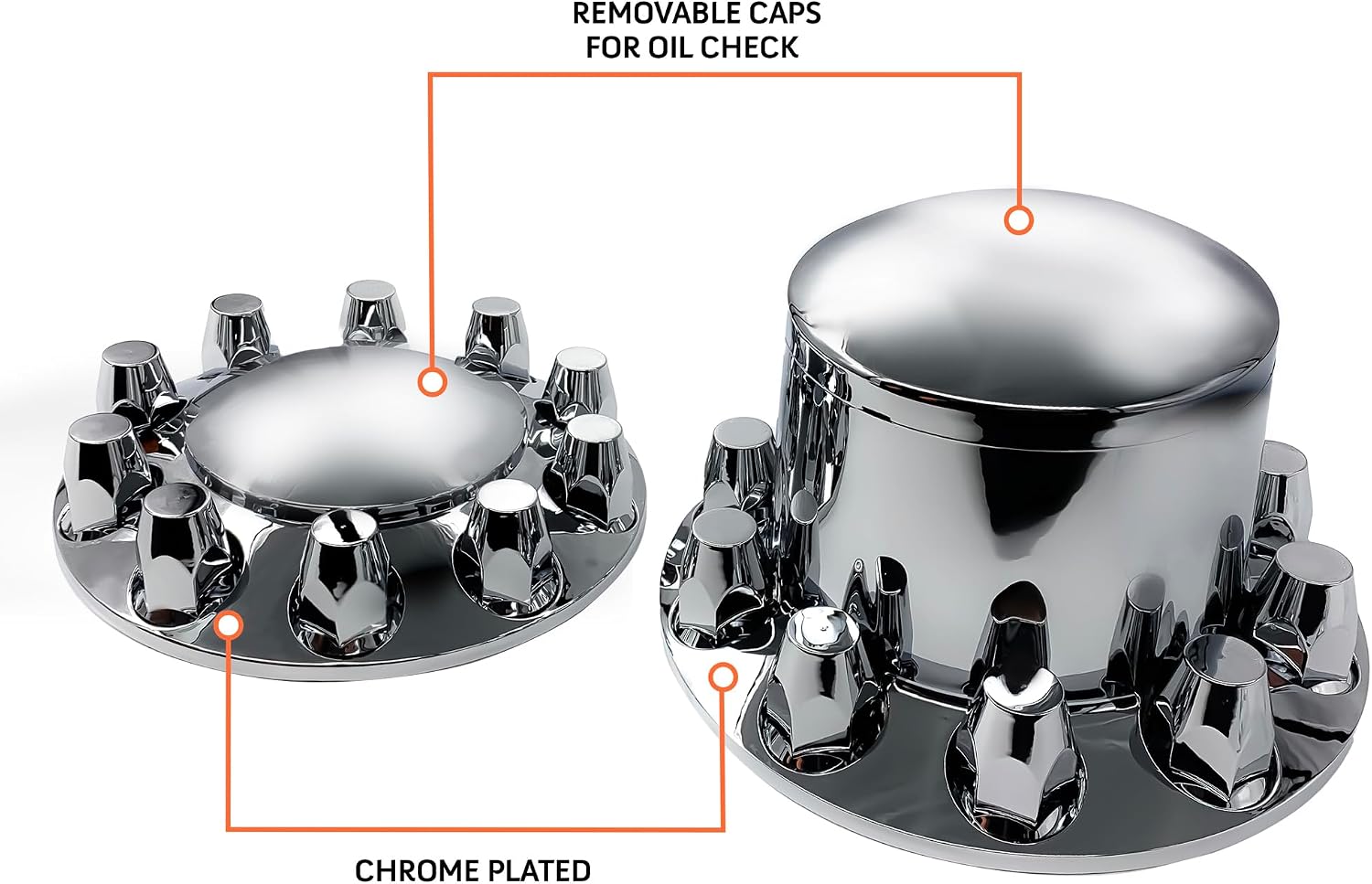
TORQUE TR082
$134.99
In stock on Amazon
Check price on AmazonMid-Range Tier: Flat-Top Covers in Chrome-Plated ABS or Polycarbonate
Flat-top covers sit nearly flush with the wheel face, projecting only 0.5 to 1 inch outward. The tradeoff is straightforward: you give up some of that light-catching depth in exchange for a more universally safe clearance profile. Flat tops are the safer spec for dual-rear-wheel positions where tire-to-tire spacing is already tight, for lowered or air-suspended builds where ride height changes alter clearance geometry, and for any application where the truck actually works hard and sees loaded highway miles — the lower profile simply has less surface area to catch debris or road turbulence. Motor Trend’s work-truck and show-truck build coverage consistently frames flat-top chrome accessories as the professional choice — polished but not theatrical — and that characterization holds true across real-world fleet and owner-operator applications.
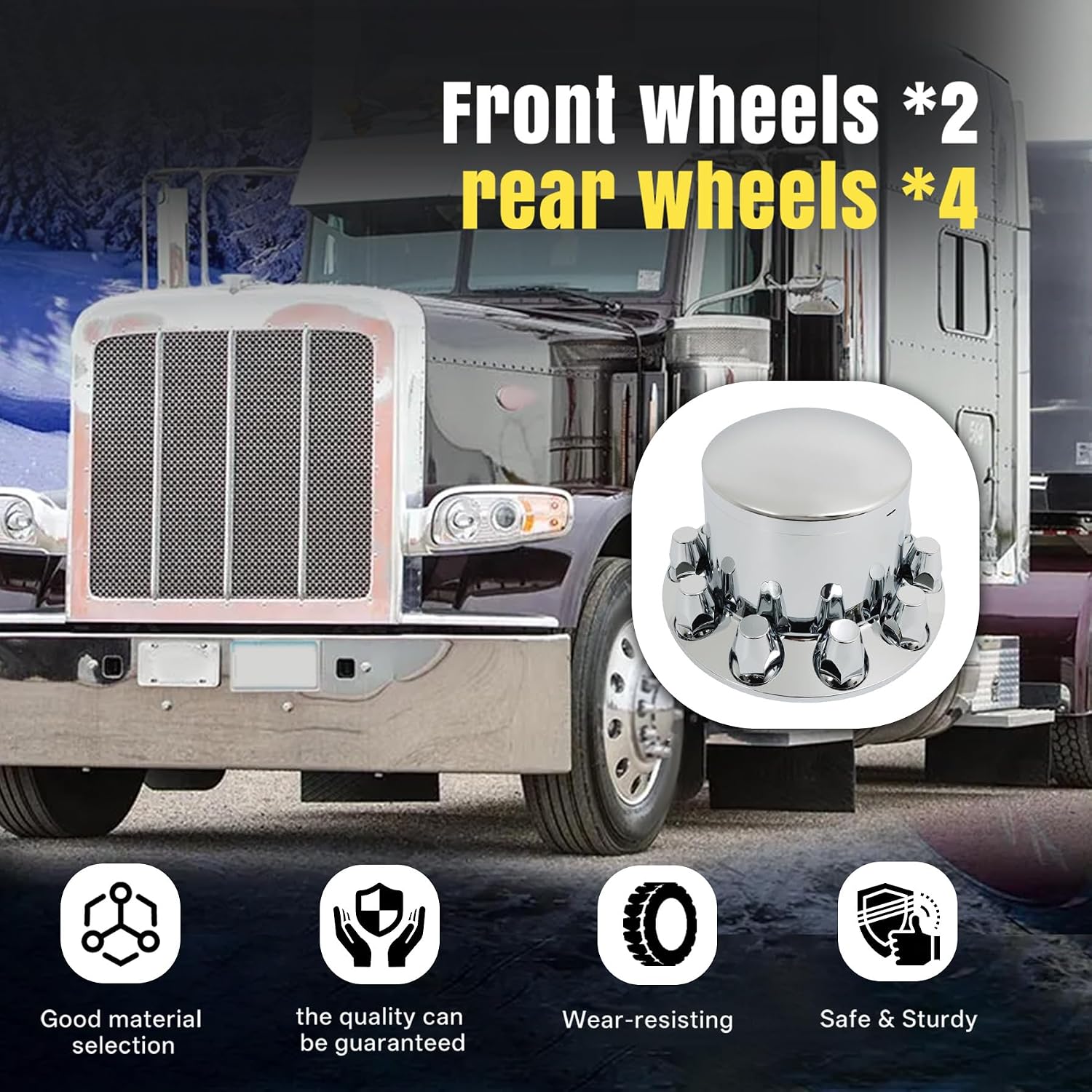
GXYWADY
$127.59
In stock on Amazon
Check price on AmazonBudget Tier: Entry-Level Stamped Steel with Chrome Plating
Stamped steel covers with a basic chrome-plated finish represent the bottom of the market. They fit the same 33mm thread-on hubs as premium billet pieces but use heavier, less refined construction and typically lack a secondary locking retainer. They’re adequate for low-mileage fleet trucks, rental equipment, or any situation where the goal is corrosion protection and minimal spend rather than show-quality finish. Hot Rod Magazine’s Chrome Accessories Buyer’s Guide — available at hotrod.com — places stamped-steel covers firmly in the protective utility category rather than the custom build category, a distinction worth keeping in mind when presenting options to a client expecting show-level results.
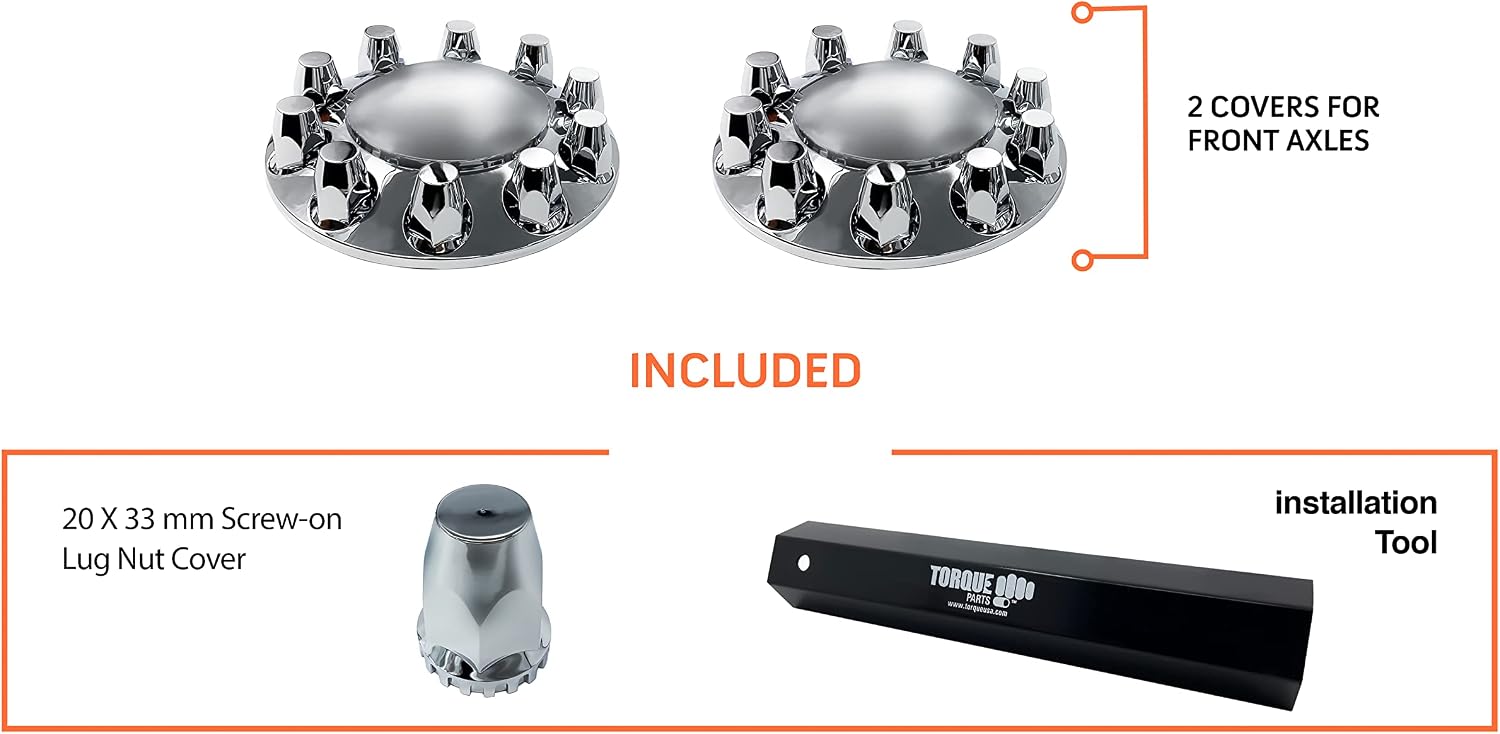
Torque TR583-TWC
$43.79
In stock on Amazon
Check price on AmazonThe decision rule is clean: if the truck is primarily a show vehicle or a statement piece that sees limited highway miles, dome covers at the premium tier are the move. If the truck works for a living or lives on dual-rear configurations with tight tire spacing, flat-top covers at the mid-range tier are the safer and more durable long-run choice. If budget is the first constraint and protection is the primary goal, entry-level stamped covers get the job done.
How 33mm Thread-On Attachment Actually Works
“33mm thread-on” shows up constantly in product listings, and it’s worth understanding precisely what it means before you order, because getting the thread spec wrong means a cover that either won’t seat properly or backs off under vibration.
The 33mm measurement refers to the thread diameter of the lug nut pilot — specifically, the inner diameter of the cover’s threaded ring that threads down over the exposed lug nut or hub pilot on Alcoa-style and similar forged aluminum truck wheels. The 33mm spec has become a de facto standard for most North American Class 8 truck fitment because it corresponds to the common 33mm hex lug nut size used across Peterbilt, Kenworth, Freightliner, International, and Mack platforms. When a cover is described as “33mm thread-on,” it means the cover screws directly onto the center hub pilot or spins down over the lug nut arrangement using an integrated threaded collar — no additional hardware required.
What trips up intermediate buyers is assuming 33mm covers are universal. They aren’t. Thread pitch matters alongside thread diameter. Most 33mm thread-on covers use a 1.5mm pitch, but some older European-derived platforms and certain specialty wheel brands use different pitches. Tire Rack’s Commercial Truck Wheel Fitment Reference Guide — available at tirerack.com — explicitly flags thread pitch as a verification step separate from diameter: diameter gets you in the ballpark, pitch confirms the fit. Always confirm both specs against your wheel manufacturer’s documentation before finalizing a purchase, especially if you’re sourcing covers for a client build where you won’t physically be there to catch a return.
Beyond thread specs, look at the cover’s retention system. Entry-level 33mm thread-ons rely purely on hand-torque of the collar, which is adequate for low-speed show use but creates vibration-loosening risk on long-haul highway applications. Mid-range and premium covers add a secondary friction or locking ring — sometimes called an anti-spin retainer — that resists backing off under sustained vibration. Operators in long-run use consistently cite the locking retainer as the single feature that separates covers they trust on the highway from covers they only trust in a show lot.
What a Full Kit Actually Costs: The Honest Number
Here’s where buyers most commonly underestimate the project. A “full kit” for a standard 18-wheel semi truck means 18 hub position covers minimum — 4 steers, 8 drives (dual rear), and 6 trailer positions. Some builds include trailer axles, some don’t, but the math on the tractor alone starts at 12 positions.
By the numbers (2026 market pricing):
| Tier | Per-Cover Price | 18-Cover Kit Total | Notes |
|---|---|---|---|
| Entry (steel, stamped chrome) | $8–$18 | $145–$325 | No locking retainer; protective utility use <a class="product-link" href="https://www.amazon.com/dp/B08HVXT6BN?tag=greenflower20-20" rel="sponsored nofollow noopener" target="_blank" title="Affiliate link — we may earn a commission.">Torque TR583-TWC — $43.79</a> |
| Mid-range (ABS/polycarbonate, chrome-plated) | $25–$55 | $450–$990 | Most popular for fleet and working trucks <a class="product-link" href="https://www.amazon.com/dp/B09ZKPXM5G?tag=greenflower20-20" rel="sponsored nofollow noopener" target="_blank" title="Affiliate link — we may earn a commission.">GXYWADY — $127.59</a> |
| Premium (billet aluminum, mirror chrome) | $85–$165 | $1,530–$2,970 | Show-truck and owner-operator builds <a class="product-link" href="https://www.amazon.com/dp/B07PFL4QH1?tag=greenflower20-20" rel="sponsored nofollow noopener" target="_blank" title="Affiliate link — we may earn a commission.">TORQUE TR082 — $134.99</a> |
| Full custom (fabricated, engraved, specialty finish) | $200–$450+ | $3,600–$8,100+ | Commissioned specialty shop work |
Those per-cover prices are the number you see in product listings. The total cost of a complete kit goes higher once you add the following line items that first-timers routinely miss.
Lug nut covers: Many builds add individual lug nut covers — small chrome caps that snap or thread over each exposed lug nut between the hub cover and the wheel face. On a steer axle with 10-lug wheels, that’s 20 additional pieces just for two positions. Lug nut covers run $1.50–$8 per piece at mid-range, which adds $50–$300 to a full tractor kit depending on coverage and quality tier.
Installation labor: If you’re not installing yourself, chrome hub cover installation at a specialty shop or truck upfitter runs $15–$40 per position depending on region and shop rate. The SEMA 2025 Market Report, Accessories & Customization Segment — published by the Specialty Equipment Market Association and available through sema.org — documents accessory installation labor benchmarks across the specialty equipment industry that are consistent with this range. On 12 tractor positions, that’s $180–$480 added to the invoice.
Valve stem extensions: On certain wheel and cover combinations, the factory valve stem becomes inaccessible once the hub cover is in place. Extended valve stems or valve stem relocation hardware add $8–$25 per position — a commonly missed line item that experienced installers and long-run operators repeatedly flag as a post-purchase surprise.
Replacement stock: Experienced professional installers and fleet customization shops typically recommend purchasing 10–15% extra covers as replacement stock, since chrome covers on working trucks see stone chips, dock strikes, and pressure-wash damage over time. Hot Rod Magazine’s Chrome Accessories Buyer’s Guide, available at hotrod.com, consistently advises this buffer for fleet builds specifically, noting that sourcing a single replacement cover from the same production run months later is often impossible if the SKU has turned over.
The honest total for a mid-range 18-cover chrome hub cover kit on a working Class 8 tractor — including lug nut covers, valve stem extensions, and professional installation — lands at $900–$1,600 installed. A premium billet show-truck kit on the same truck, fully installed with all ancillary hardware, realistically runs $2,500–$4,200.
Fitment Verification: The Steps You Cannot Skip
Even experienced buyers get caught skipping fitment verification steps on hub covers because the parts look simple. They’re not infinitely forgiving. Before finalizing any hub cover order for a client build or your own rig, work through these four checks in order.
1. Confirm your wheel brand and center bore diameter. Alcoa Dura-Bright, Accuride, and aftermarket forged aluminum wheels may share the same lug pattern but have different center hub configurations. Hub cover fitment is specific to wheel brand and model, not just lug pattern.
2. Measure your existing hub pilot protrusion. The distance the hub pilot extends beyond the wheel face determines whether a dome-profile cover will sit properly or bind. This is a five-minute job with a depth gauge that prevents a return-shipping headache.
3. Verify thread diameter and pitch as separate checks. As Tire Rack’s Commercial Truck Wheel Fitment Reference Guide — tirerack.com — advises, these are two distinct specifications. Confirming diameter alone is not sufficient to guarantee correct thread engagement. A thread pitch mismatch across 18 positions is an expensive lesson.
4. Confirm tire clearance at full steering lock for steer axle positions, especially with dome covers. Motor Trend’s work-truck build coverage at motortrend.com identifies this as the most consequential skipped step in first-time installations on working trucks, and it is non-negotiable on any tractor that will see loaded highway miles.
The Clear Decision Frame
If you’re outfitting a show truck or owner-operator’s pride-and-joy tractor where aesthetics drive the decision and highway miles are moderate: spec dome covers in billet chrome at the premium tier, budget $2,500–$4,200 fully installed for a complete tractor kit, and don’t skip lug nut covers — show lighting makes the gap between the hub cover edge and bare lug nuts immediately visible.
If you’re outfitting a working fleet truck, a dual-rear configuration build, or a client vehicle that will see hard miles and loaded highway operation: spec flat-top covers at the mid-range tier with locking retainers confirmed in the spec sheet, budget $900–$1,600 fully installed, and purchase replacement stock upfront rather than chasing a discontinued SKU six months down the road.
If budget is the hard constraint and corrosion protection is the primary goal: entry-level stamped-chrome covers at the $145–$325 kit range do the protective job, with the understanding that they are not a show-quality finish solution and will require more frequent inspection on highway-mileage trucks without locking retainers.
If the thread spec on the target vehicle is anything other than confirmed 33mm / 1.5mm pitch — verify against wheel manufacturer documentation before ordering a single piece. Tire Rack’s Commercial Truck Wheel Fitment Reference Guide treats thread pitch and thread diameter as independently mandatory verification steps, not a single combined check. A thread mismatch across 18 positions is an expensive confirmation that fitment details are never safely assumed.
The chrome hub cover category looks simple from the outside. The buyers who avoid regret are the ones who treat fitment verification and true total cost as non-negotiable first steps, not afterthoughts.
How the Tiers Compare
For readers weighing price against capability, here’s how the standout picks break down by budget level.
Best Budget Pick
At $43.79, this is the value option in this lineup — it covers the essentials without the premium-tier cost, the smart starting point if you’re weighing price against capability.
Torque TR583-TWC
$43.79
In stock on Amazon
Check price on AmazonBest Mid-Range Pick
At $76.99, this is the balanced choice — it closes most of the gap to the high end while staying well short of premium pricing, which is why it’s the pick most buyers actually land on.
GXYWADY
$127.59
In stock on Amazon
Check price on AmazonBest Premium Pick
At $134.99, this is the top performer here — you pay for it, but if capability and longevity matter more than the upfront cost, this is the one to beat.
TORQUE TR082
$134.99
In stock on Amazon
Check price on Amazon